Copied certificates
A laboratory or brand certificate can be scanned and reprinted. Even when the certificate number belongs to a real record, the eye cannot tell whether the document itself is a copy.


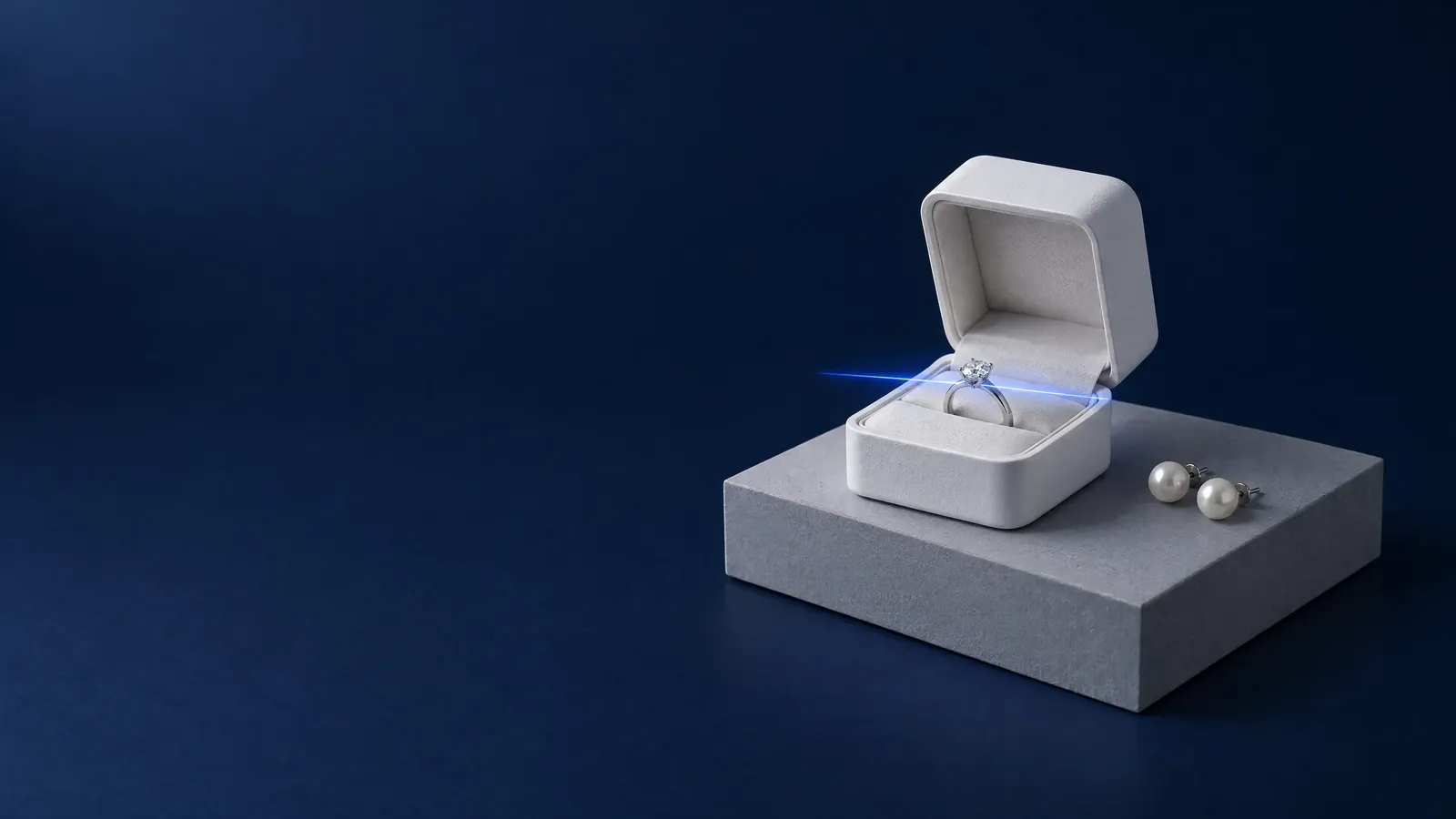
A diamond certificate or warranty card is often the only printed document that shows what a piece is worth. The Grafex signature goes into the existing design of these documents and is read with a phone.
Implementation
Grafex works a signature that cannot be seen by eye into a jewellery brand's product certificate, warranty card and box. The document's layout, logo and any security background stay the same, and it is printed by the same printer. A certificate that does not carry the signature does not get a genuine result in the mobile app. Store staff, wholesalers, appraisers and customers check the document with the same app.
In jewellery, value lies in properties the eye cannot judge; stone quality and metal fineness are only established by testing. Buyers usually learn them from the certificate and warranty card. When the document itself is copied, an ordinary stone or a lower-carat piece can be sold with paperwork that looks identical to the real thing. With orders delivered by courier, the buyer also has no shop window to compare the box and card against.
Request a meeting
Data
Share of customs seizures of counterfeit watches, leather goods, handbags and jewellery worldwide in 2011-2013 that involved postal and express shipments
Source: EUIPO, 2020 Status Report on IPR Infringement, 2020 (citing the OECD-EUIPO study on small parcels)Risks
A laboratory or brand certificate can be scanned and reprinted. Even when the certificate number belongs to a real record, the eye cannot tell whether the document itself is a copy.
A ring or necklace bought online arrives by courier with its box and card. The buyer has no store to compare it with.
In wholesale deals the piece changes hands with its certificate. Without a shared way to check the document, trust rests on personal acquaintance.
For branded watches and jewellery, the box and warranty card directly affect resale price. Copy sets are sold separately to profit from that difference.
Example scenario
Certificate, warranty card and box files are reviewed. The signature goes into the design without touching the certificate number, fineness or stone fields.
Documents are printed at the existing printer. Samples from the first run are scanned to confirm the signature reads.
The sales adviser scans the certificate with the customer when handing over the piece. For orders sent by courier, the customer runs the same scan when opening the parcel.
When a piece is resold or brought in for servicing, the certificate is scanned again. Documents that do not come back genuine appear in the dashboard with the city where they were scanned.
FAQ
The first step is to look up the certificate number in the issuing body's records. If the document carries a Grafex signature, a phone scan also shows whether it is that body's own print; a document without the signature does not get a genuine result.
No. A scan shows that the document and box are genuine. Stone quality and metal fineness need to be examined by a gemmological laboratory or an assay office.
No. Logo, text layout and data fields stay the same and the signature cannot be seen by eye. Certificates continue to be printed at your current printer.
Yes. A wholesaler or retailer installs the app on a phone and scans the documents of incoming pieces. No separate device or permission is needed.
Every scan is stored with date, location and result. The system can run in the cloud, or on-premise if records need to stay on the brand's own infrastructure.
Other industries
 Luxury goodsAn invisible signature on boxes, product cards and warranty cards; advisers and buyers scan by phone.
 Textile and apparelAn invisible signature on swing tags, printed labels and shoe boxes; stores and buyers verify by phone.
 Cosmetics and personal careAn invisible signature on cartons, tubes and bottle labels; staff and shoppers check the product by phone.
Meeting request
The first meeting reviews your product, sales channels and the risks you face, and recommends a suitable method.
Request a meeting