Scanned and reprinted cartons
A high-resolution scan and offset reprint produce a carton whose colours and text are very close to the original. A pharmacist or warehouse clerk checking by eye usually cannot separate it.


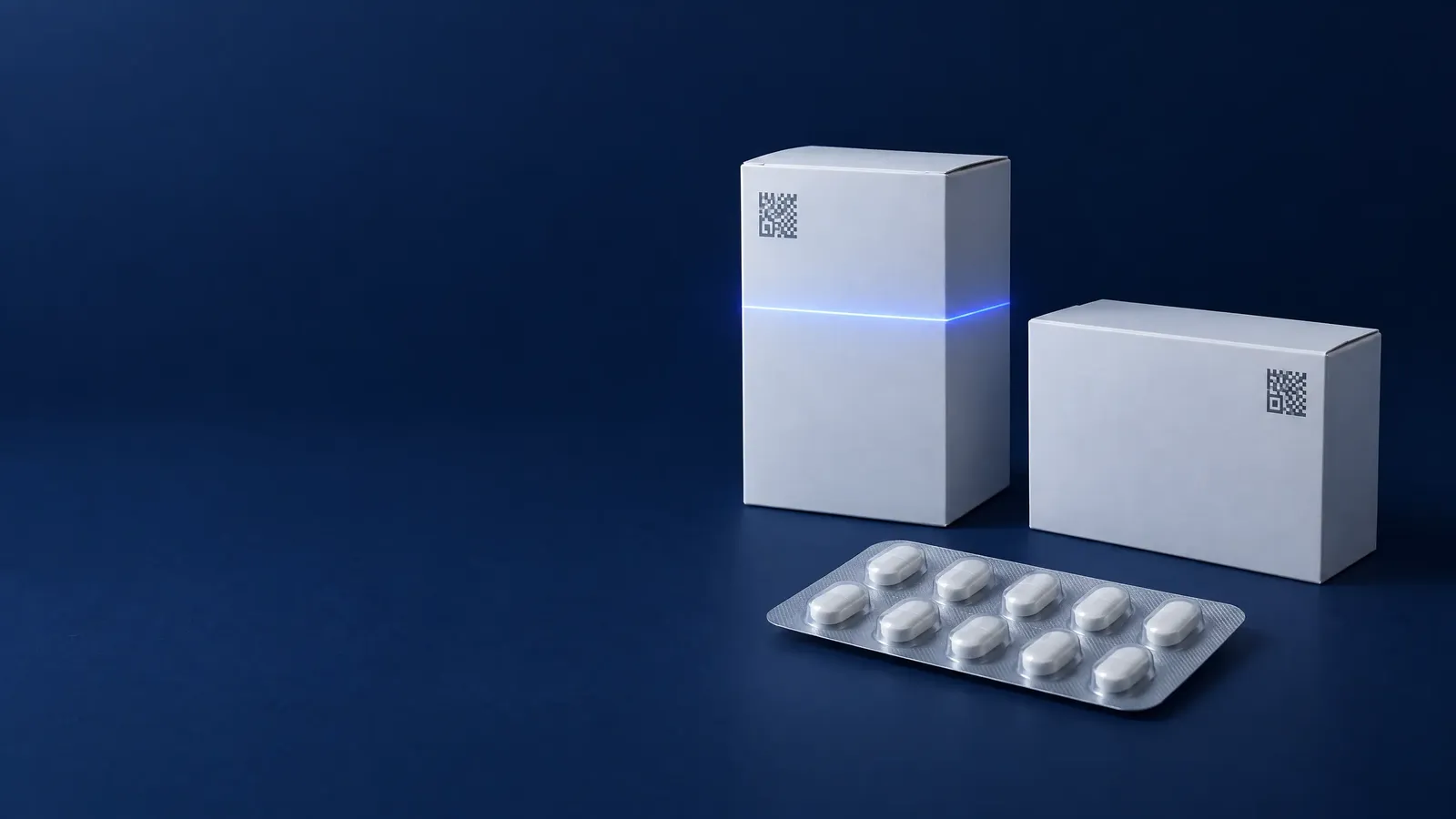
The Grafex signature is worked into the approved carton artwork and printed on the same line. A pharmacist, warehouse clerk or patient scans the carton with a phone and sees whether the pack came from the marketing authorisation holder.
Implementation
Grafex places a signature that cannot be seen by eye into the existing print file of a medicine's outer carton. The carton is printed by the same supplier with the same printing method, and the data matrix area and regulatory text stay where they are. A carton that does not carry the signature does not give a genuine result in the mobile app, even if its data matrix is valid. Every scan is stored with date and location, and the dashboard shows which provinces or markets suspicious results cluster in.
When a fake carton is printed close to the original, a pharmacist struggles to tell them apart by eye. In Turkey the İTS data matrix serialises every carton and records its movements; in the EU, Delegated Regulation 2016/161 requires a unique identifier and an anti-tampering device on the outer pack of prescription medicines and of certain listed non-prescription medicines. These systems check whether the code is registered. Whether the board and print actually came from the authorisation holder's printer is a separate question, and it comes up most in export markets, with sample packs and with medicines brought in from abroad.
Request a meeting
Data
Estimated minimum share of medicines in low- and middle-income countries that are substandard or falsified
Source: World Health Organization, Substandard and falsified medical products fact sheet, 3 December 2024Share of customs seizures of counterfeit pharmaceuticals worldwide in 2014-2016 that involved postal and express shipments
Source: EUIPO, 2020 Status Report on IPR Infringement, 2020 (citing the OECD-EUIPO study on counterfeit medicines)Risks
A high-resolution scan and offset reprint produce a carton whose colours and text are very close to the original. A pharmacist or warehouse clerk checking by eye usually cannot separate it.
The code from a genuine carton can be printed onto a fake one unchanged. Scanning it reaches the record in the system, but it says nothing about which printer produced the carton.
Outside İTS, distributors and pharmacists may have no common tool for checking a carton. When the same app works the same way in every country, the warehouse, the pharmacy and the patient all run the same check.
A patient or relative who has a medicine sent from abroad receives it with nothing to compare it against. A phone scan gives them a concrete reason to take a suspicious carton to the pharmacist or the company.
Example scenario
The carton artwork filed with the authority and a printed sample are reviewed. The signature goes into the design without touching the data matrix area or the regulatory text.
The packaging supplier prints the carton on its existing line. During proofing, cartons taken from the line are scanned to confirm the signature reads.
Warehouse staff scan a few cartons from a suspect batch with the mobile app. The result appears the moment they scan and is recorded with date and location.
A pharmacist who has doubts scans the carton before handing it over, and the patient can run the same check at home. Scans that do not come back genuine are collected in the dashboard and passed to the company's quality assurance team.
Regulation
Launched by the Ministry of Health in early 2010, İTS serialises medicine cartons with a data matrix and records every movement from production to dispensing with location and time. The Grafex signature is a separate check alongside the code; it does not replace İTS notifications or change where the code sits.
Under the 26 February 2024 revision of the guideline, the authorisation holder submits planned changes to packaging information to the agency first, and the agency also reviews the pack mock-up for design and readability. Whether a print file carrying the signature needs to be notified is for the company's regulatory affairs team to decide.
In the EU, prescription medicines (unless exempted) and certain listed non-prescription medicines must carry a unique identifier and an anti-tampering device on the outer packaging; the verification rules have applied since 9 February 2019. On cartons exported to the EU, the Grafex signature is printed alongside these safety features and does not replace them.
This section is for information only; official sources prevail for current obligations.
FAQ
Yes. The data matrix is a printed symbol and can be lifted from a genuine carton and printed onto a fake one unchanged. Scanning it reaches the record in the system, but you cannot tell from that scan which printer made the carton. If the carton carries a Grafex signature, a phone scan answers that second question; a carton without the signature does not get a genuine result.
No. İTS notifications and the EU safety features are legal obligations and continue as they are. Grafex is a separate check on the carton print and does not replace laboratory analysis when the contents are in doubt.
The signature does not change the carton's appearance, text or data matrix area. Whether the print file change has to be notified to TİTCK is decided by the authorisation holder's regulatory affairs team; during the needs analysis we show that team exactly how the signature sits in the file.
The carton is scanned with the mobile app on a smartphone and the result appears straight away. No separate reader or user permission is needed.
Labels and inner packs are assessed if the printing method and material are suitable. Suitability is decided during the needs analysis from the print file and a sample pack.
Other industries
 Food supplementsAn invisible signature on supplement cartons and bottle labels; pharmacists and buyers verify by phone.
 Cosmetics and personal careAn invisible signature on cartons, tubes and bottle labels; staff and shoppers check the product by phone.
 Food and beverageAn invisible signature on olive oil labels, honey jars or cheese packs; shops and shoppers scan by phone.
Meeting request
The first meeting reviews your product, sales channels and the risks you face, and recommends a suitable method.
Request a meeting