Holograms, QR codes and invisible digital signatures do three different jobs on a pack: a hologram is an optical security element visible on the shelf, a QR code is a visible code that connects a phone to the brand's online information, and an invisible digital signature is a mark embedded in the print and read by software. Grafex is a product authentication technology that adds an invisible digital signature to the packaging design and lets anyone verify a product's authenticity with a smartphone, so we are a party to this comparison. That is why we have sourced the strengths of each method and left the choice to your product's risk.
Do the three methods answer the same question?
No. The choice gets confusing because all three are filed under "packaging security", yet each answers something different:
- Hologram: "Does this pack carry the brand's security element?" The person looking at the pack answers it.
- QR code: "Where are the brand's information and records for this product?" Anyone with a phone can ask; the brand's server answers.
- Invisible digital signature: "Is this the brand's own print?" The person scanning with the app asks; the measurement taken during the scan answers.
Compare them without this distinction and each gets judged by the wrong yardstick, such as expecting records from a hologram or shelf deterrence from a QR code.
What are the strengths of holograms?
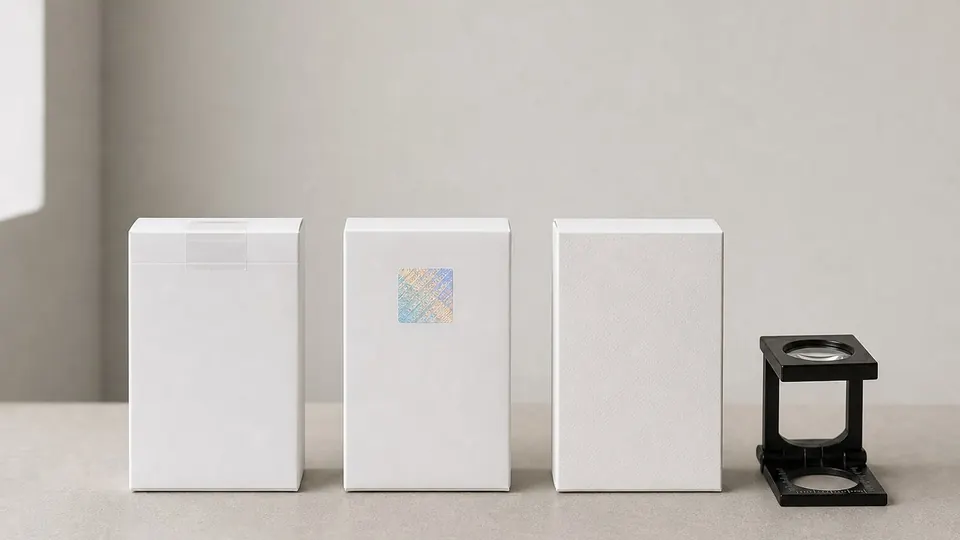
According to the EUIPO's anti-counterfeiting technology guide, security holograms are diffractive optical devices whose image changes with lighting and viewing angle, and they cannot be reproduced by colour printers, scanners or cameras. Their complexity can be raised by adding several images and effects. In practice that means:
- A counterfeiter who scans and reprints the pack cannot get the hologram that way.
- No device is needed; the hologram is visible on the shelf and signals that the product is protected.
- A distributor, customs officer or quality team with a reference sample can spot a difference on the spot.
The same guide states what needs care: authenticating a hologram requires knowledge of the original, because differences only show in comparison, and every design change has to be taken into account. We cover the ways holograms are counterfeited and what to ask when choosing one in can holograms be counterfeited, so we will not repeat it here.
What are the strengths of QR codes?
Almost every smartphone camera reads a QR code, which makes it the easiest way to take a consumer to the brand's page without a separate app. GS1's Digital Link standard gives a consistent way to express GS1 identification keys, such as the product number, inside web addresses so that they link to online information and services. The same code can serve product information, instructions or campaigns.
The EUIPO guide describes the QR code's place in security in balanced terms. A serialised code can retrieve item-level data; the platform may collect data about scans, and analysing that data can help detect counterfeiting and illicit activity. The same guide says QR codes by themselves do not offer protection against copies, but combined with authentication technologies such as holograms, copy detection patterns or unique identifiers they can provide automated authentication via a smartphone scan.
There is one more practical risk: the US Federal Trade Commission warns that scammers can stick their own QR codes over real ones. A brand that uses QR codes should therefore tell consumers which domain the code opens.
What are the strengths of an invisible digital signature?
The EUIPO defines a digital watermark as information permanently embedded in a file; when it is invisible, only software or a machine can decode it. On a pack, that information sits in the design file and reaches the box with the print. Its strengths:
- It takes up no space on the pack; nothing new is added to the design and there is no separate application step.
- The counterfeiter cannot see what to imitate.
- Anyone with a phone and the app can scan, and every scan can be recorded.
How it behaves against copies depends on the type of mark. Robust watermarks are designed to keep proving ownership of the file even when the content changes. With copy detection patterns, as the EUIPO explains, information is lost with every print and scan, which is what separates the copy. So the question for a supplier is "if our pack is scanned and reprinted, what does the check show?" Details are in digital watermarks on packaging.
The limits are clear too: it is invisible on the shelf, so consumers have to be told that verification exists and how to do it; it depends on print quality; and packs printed off the books from the approved file carry the signature as well.
Which one fits which situation?
- If you want a shelf-visible cue that needs no device, a hologram stands out. Add tamper evidence if you also need to show whether the pack has been opened.
- If you want to connect consumers to product information, instructions or campaigns, a QR code stands out.
- If you want to follow individual packs on record, you need a serialised code and a record behind it that monitors scans.
- If you want to separate copied packs with a phone without touching the design, an invisible digital signature stands out.
- If you face more than one risk, combine methods. ISO 22383:2020 provides criteria and a method for deciding which authentication elements to use after a counterfeiting risk assessment.
| Goal | Hologram | QR code | Invisible digital signature |
|---|---|---|---|
| Visible cue on the shelf | Suitable | Visible, but not a security cue | Not suitable |
| Check without a device | Suitable if a reference is at hand | Needs a phone | Needs a phone and app |
| Separating copies on its own | Suitable against ordinary printer copies | Not suitable on its own | Depends on the mark; test it |
| Information and contact for consumers | Not suitable | Suitable | Limited |
| Scans on record | Not suitable | Suitable if serialised | Suitable |
| Space needed in the design | Yes | Yes | No |
Can they be used together?
Yes, and that is often the most balanced outcome. The EUIPO also describes QR codes combined with technologies such as holograms and copy detection patterns. A sample setup: a hologram visible on the shelf, a QR code that takes consumers to the product page, and an invisible signature read by phone that separates copies. Each layer serves a different person and a different question, so none replaces another. To turn this into a prevention plan, see how to prevent packaging counterfeiting.
Where does Grafex sit in this choice?
Grafex is on the invisible digital signature side. The signature is placed inside the existing packaging design to suit the printing method and material; no new visual element, logo or code is added and the pack is printed on the existing line. Because the signature is generated from a brand-specific key, packaging that does not carry it, or does not match the key, does not get a genuine result at verification, which makes the pack copy-resistant. Company teams, distributors and consumers scan the product with a smartphone, and every scan is recorded with date and location. If the pack already carries a hologram or a QR code, Grafex works alongside them. Details are on the technology page.
Frequently asked questions
Are holograms no longer useful?
They are. According to the EUIPO, holograms cannot be reproduced by colour printers, scanners or cameras, and they are a visible deterrent on the shelf. For a reliable check, the person checking needs to know the original.
Does a QR code reveal a fake?
Not on its own, because a copied pack can carry the same code. With serialised codes, analysing scan data can help spot counterfeiting; that is the work of the record behind the code.
How will consumers know an invisible signature is there?
The brand has to tell them. If the pack, the website or the product page does not explain how to verify, consumers will not scan.
Can an invisible signature and a QR code be used on the same pack?
Yes. They do different jobs, so they can be used together. A trial print should confirm that neither element affects how the other reads.
Sources
- EUIPO, Security Holograms
- EUIPO, Two-Dimensional Barcodes
- EUIPO, Digital Watermarks
- EUIPO, Copy Detection Patterns
- GS1, GS1 Digital Link
- Federal Trade Commission, Scammers hide harmful links in QR codes to steal your information (6 December 2023)
- ISO 22383:2020, Guidelines for the selection and performance evaluation of authentication solutions for material goods (ISO)