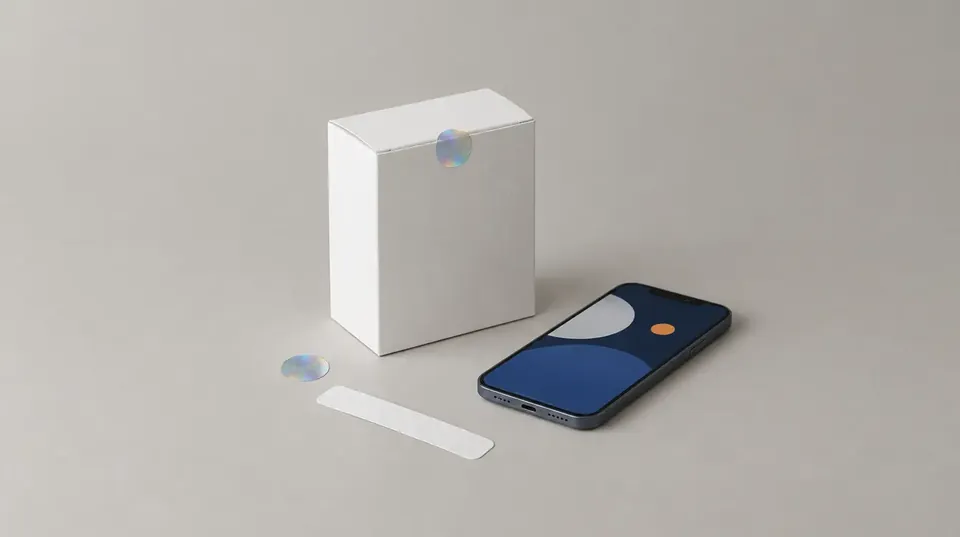
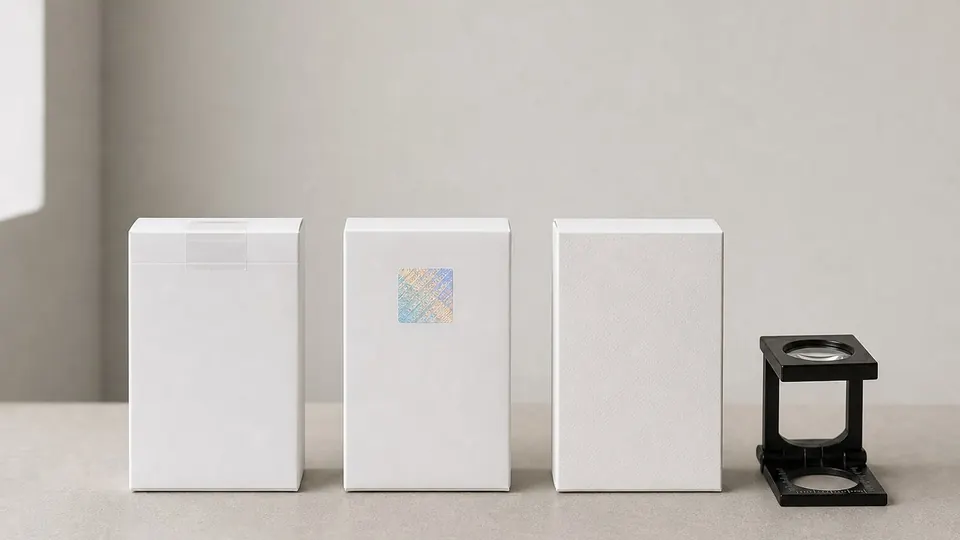
A digital watermark on packaging is information embedded invisibly in the artwork file, carried onto the pack by the print itself and read by software through a camera. Nothing new is added to the design: no label and no visible code. A QR code is a visible code and a hologram is an optical element. What really separates the three is what happens when the pack is copied.
What exactly is a digital watermark?
The EUIPO anti-counterfeiting technology guide defines a digital watermark as information permanently embedded in a digital file that certifies its authenticity and source. It can be visible, like a TV channel's logo in the corner of the screen. When it is invisible, only a computer program or machine can decode it.
Much of what you find when searching the term concerns logos on stock photos or labels on AI-generated content. The packaging use applies the same idea to print: the mark sits in the design file and is read from the printed surface.
How does it work on a pack?
In outline there are four steps:
- The mark is placed in the design file with the print method and substrate in mind.
- The packaging is printed in the normal production process.
- A camera passes the image to software, which looks for the mark.
- The result is shown to the user and, if a system is in place, recorded.
Security is not the only use. HolyGrail 2.0, a project run by AIM, the European Brands Association, tested imperceptible codes the size of a postage stamp, spread across the surface of consumer packaging and read by cameras on waste sorting lines. The aim was accurate sorting of packaging waste, not proof of authenticity. That example makes a useful point: saying a pack has a watermark does not tell you what the watermark is good for.
Robust mark or copy-sensitive mark?
EUIPO separates watermarks into robust and fragile according to how well they withstand changes to the data they sit in. A robust watermark is built to remain provable even after significant modification. That is the right property for recognising a crushed, dirty bottle on a sorting line.
Authentication is a different problem. If a mark gives the same result on a pack that has been scanned and reprinted, the copy reads as valid too. EUIPO describes a related technology, copy detection patterns, as images designed to be sensitive to printing and copying, with verification based on comparing the information in the scanned pattern against the original. So the buying question is not "do you use a watermark?" but "what does the scan show when our pack has been scanned and reprinted?"
How do watermarks, QR codes and holograms compare?
| Invisible digital mark | QR code | Hologram | |
|---|---|---|---|
| Visible on the shelf? | No | Yes | Yes |
| Who can check it? | Anyone with the app | Anyone with a phone | Someone who knows the original |
| What is needed? | Phone and app | Phone camera | The eye and a reference to compare |
| Effect on design | No new element | Space for the code | Space and a separate application step |
| What happens when copied? | Depends on the type of mark, so test it | The copy carries the same code | Not with an ordinary printer, but other routes exist |
The EUIPO guide is plain about QR codes: by themselves they offer no protection against copies. With serialised codes, analysis of scan data can help detect counterfeiting, but that is the work of the record behind the code rather than the code itself. The same guide says holograms cannot be reproduced by colour printers, scanners or cameras, while noting that authenticating one requires knowledge of the original. We look at how holograms get counterfeited in a separate post, and at barcodes in can a barcode tell you whether a product is genuine.
What are the limits of an invisible mark?
- No deterrent on the shelf. Consumers cannot see that the product is protected, and they need to be told how to scan it.
- Dependence on print quality. The print is part of the measurement, so colour shift or misregistration can disrupt scanning. We list the clauses to agree with your printer in a print specification for invisible signatures.
- No answer to leaks on its own. A pack overprinted from the marked file carries the mark as well. We separate those cases in copied packaging or printer overrun.
- No view of the contents. A refilled genuine pack can return a valid result. Tamper evidence tells you whether it was opened, and a laboratory tells you what is inside.
What should you ask before choosing a method?
- What does the scan show when our own pack has been scanned and reprinted?
- Which print methods and substrates does it read on, and within what tolerances?
- How many result states are there, and what does the user see when a reading is inconclusive?
- Who will do the scanning, and do they need authorisation or training?
- Where are scans stored, and with what details?
- Which test is repeated when the printer or material changes?
Where does Grafex's invisible signature fit?
Grafex's invisible signature is also a mark placed inside the packaging design in a way suited to the print method and read with a smartphone. The design does not change and the pack is printed on the existing line. Because the signature is generated from a brand-specific key, packaging that does not carry it, or does not match the key, does not get a genuine result at verification, and each scan is recorded with date and location. The scope is on the solutions page.