Packaging security is the ability of a pack to give a reliable answer to three questions: has it been opened, is the packaging itself the brand's own print, and which individual product does this pack belong to? Each question is answered by a different technology and by a different person. That is why packaging security is not about picking one feature, but about building complementary layers around who will check them and with what.
Which questions does packaging security answer?
| Question | Layer that answers it | Typical example |
|---|---|---|
| Has the pack been opened? | Tamper evidence | Breakable cap, tape, void label |
| Is the packaging genuine? | Authentication elements | Hologram, security ink, invisible signature |
| Which pack, and where has it been? | Unique code and serial number | Data matrix code, tax stamp, serialised label |
| Is the content genuine? | Laboratory analysis | A sample taken from the product itself |
The last row matters: no feature on the packaging measures the content. When an original pack is refilled, an authenticity check says "genuine"; only tamper evidence or a laboratory reveals the refill.
What does tamper evidence do?
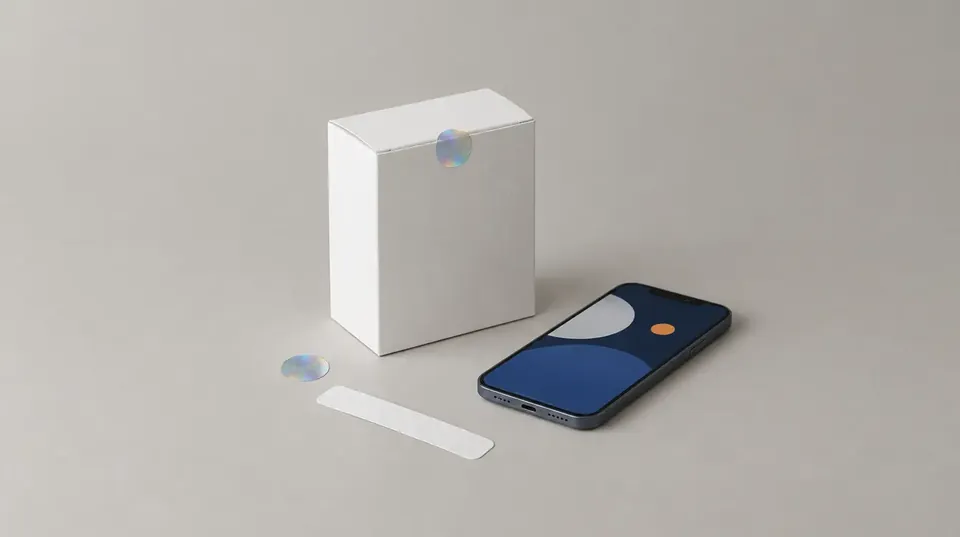
Tamper evidence shows whether a pack has been opened for the first time. The EUIPO anti-counterfeiting technology guide gives void labels as an example: when the label is peeled off, the word "void" or a logo is left on the surface, and the warning still shows even if the label is stuck back on. The check is visual; no reading device is needed.
In pharmaceuticals this layer is mandatory. EU Delegated Regulation 2016/161 defines the anti-tampering device on prescription medicine packs as the safety feature allowing verification of whether the packaging has been tampered with. ISO 21976:2018 sets out requirements for applying and checking tamper verification features on medicinal product packaging.
The limit is clear: a copied pack printed from scratch comes with its own tape and seal. Tamper evidence does not tell you whether the packaging is a copy.
How are overt, covert and forensic features different?
The EUIPO guide defines overt features as those an average person can notice without tools or training, and covert features as those visible only with an additional tool or training. The industry adds a third level, forensic features. These are verified in a laboratory; the EUIPO page on chemical encoding and tracers states that coded particles are decoded in a laboratory.
The three levels also decide who does the checking. Consumers can check an overt feature, but so can the counterfeiter see it. Field teams check covert features with a lamp or reader. Forensic features produce evidence in disputes and court cases, but give no result on the shelf. We covered the hologram's place in this picture in can holograms be counterfeited, and the effect of each feature on the packaging process in packaging security features.
What do serial numbers and unique codes prove?
Serialisation gives each pack its own identity. EU Delegated Regulation 2016/161 defines the unique identifier as the safety feature enabling verification of authenticity and identification of an individual pack. The code is printed as a two-dimensional Data Matrix; the pharmacy verifies it when supplying the product and decommissions it in the repositories system. When the same code is scanned a second time, the system notices. In Türkiye the data matrix code and the Pharmaceutical Track and Trace System (İTS) do this job for medicines; we summarised it on the pharmaceuticals page. In Türkiye, alcoholic drinks and tobacco products carry a tax stamp under the Product Tracking System that plays this role. ISO 22382:2018 gives guidelines for the content, security, issuance and examination of tax stamps; overt and covert security features as well as serialisation and unique identifier codes are within its scope.
The strength of a unique code lies in the record behind it. The code itself is a printed symbol and can be lifted from an original pack and printed unchanged on a copy. The record shows whether the code has been scanned before; it does not show whether the pack came from the brand's printer. We explained this distinction in can a barcode tell you whether a product is genuine.
What do print-level features add?
Some features are not a separate label or part but sit inside the pack's print: microtext, guilloche patterns, security inks and invisible marks read by software. Their shared advantage is that they appear in every print run without adding a new part. We covered how invisible marks work in digital watermark on packaging, and how they compare with inks in invisible ink or digital signature.
Their shared weakness is that they depend on the print. When the printer, material or ink changes, the feature must be tested again. We collected the clauses to agree with the printer in print specification. Packaging overprinted from the approved file carries the same feature too; we discussed that risk in printer overrun.
How are the layers combined?
The rule for layered protection is simple: each layer should serve a different question and a different checker. Adding two features that answer the same question raises cost without raising protection by the same amount.
| Who checks | Tool at hand | Layer that works |
|---|---|---|
| Consumer | Eyes, phone | Tamper evidence, overt feature, mark read by phone |
| Dealer, pharmacist, store | Phone, reader | Unique code, mark read by phone |
| Quality and field team | Lamp, reader, training | Covert features |
| Laboratory | Analytical equipment | Forensic features, content analysis |
A common structure looks like this: a cap or tape for opening, a layer embedded in the print for the authenticity of the packaging, a unique code where regulation requires it, and a laboratory for disputes. Risk decides which layer comes first.
How do you decide?
- Define the risk. Copied packaging, refilling, overruns or parallel imports? Each calls for a different layer.
- Choose the checker. Consumer, dealer or field team? The tool they will have decides the layer.
- Separate the mandatory items. Legal elements such as data matrix codes, tax stamps and anti-tampering devices are not up for selection; the other layers sit alongside them.
- Account for the print process. How much does the feature change the design, the suppliers and the approval cycle?
- Think about the record. Is the result of the check stored somewhere, or does it stay with the person who checked?
- Measure with a pilot. Try the chosen structure on one product or batch and expand based on the scans in the field.
ISO 22383:2020 provides a framework for this process: after a counterfeiting risk assessment, it helps decide which categories of authentication elements are needed and how to select them. ISO 12931:2012, which covered the same subject, was withdrawn and replaced by ISO 22383:2020; specifications that still cite it should be updated.
Where does Grafex sit among these layers?
Grafex is an authenticity layer that works at print level. The invisible signature sits inside the existing packaging design, suited to the printing method and material; no new visual element, logo or code is added to the packaging and the packaging is printed on the existing line. Because the signature is generated from a brand-specific key, packaging that does not carry it, or does not match the key, does not get a genuine result at verification. Company teams, dealers and consumers scan the product with a smartphone; every scan is recorded with date and location. Grafex does not replace tamper evidence, data matrix codes or tax stamps; it is used alongside them. The scope is on the solutions page.
Frequently asked questions
Are packaging security and product safety the same thing?
No. Product safety is about the product not causing harm in use. Packaging security is the ability of the pack to prove whether it has been opened, whether it is genuine and which individual product it belongs to.
Is a single security feature enough?
Usually not, because each feature answers a different question. Tamper evidence shows opening, an authentication element shows copying, and a unique code shows the identity of the pack.
If there is a data matrix code, is a separate authentication element still needed?
A data matrix code identifies the pack in the record, but it can be printed unchanged on a copy. A separate authentication element shows whether the packaging is the brand's own print.
Which layer should come first?
The one for the highest risk. If copied packaging is the problem, the authenticity layer comes first; if refilling is the problem, tamper evidence does. Regulatory elements apply in every case.
Sources
- EUIPO, Anti-counterfeiting and anti-piracy technology guide: Glossary
- EUIPO, Void Labels
- EUIPO, Chemical Encoding and Tracers
- Commission Delegated Regulation (EU) 2016/161, EUR-Lex
- Turkish general communiqué on the Product Tracking System for tobacco products and alcoholic drinks (mevzuat.gov.tr, in Turkish)
- ISO 21976:2018, Packaging: Tamper verification features for medicinal product packaging (ISO)
- ISO 22382:2018, Guidelines for the content, security, issuance and examination of excise tax stamps (ISO)
- ISO 22383:2020, Guidelines for the selection and performance evaluation of authentication solutions for material goods (ISO)
- ISO 12931:2012, Performance criteria for authentication solutions used to combat counterfeiting of material goods (ISO)